Table of Contents
ToggleBiomass Briquette Machine Price in India 2026 – Updated Guide
The cost of Biomass briquette machine in India by 2026 will be determined by a number of factors including capacity of production, level of automation, type of raw material used and quality of the brand. The total cost is determined depending on the specifications of a machine, the quality of its build, as well as the production rate needs.
The small capacity Biomass briquette machines are suitable in startups and small industries that intend to transform agricultural waste into fuel briquettes. Commercial biomass fuel production units, factories and exporters have appropriate medium and large-scale machines.
In case you plan to invest in a biomass briquette machine in 2026, it will be good to know the features and capacity of the machine, durability, and after sales support to enable you to make the right choice of the machine that fits best on your business.
What is a Biomass Briquette Machine?
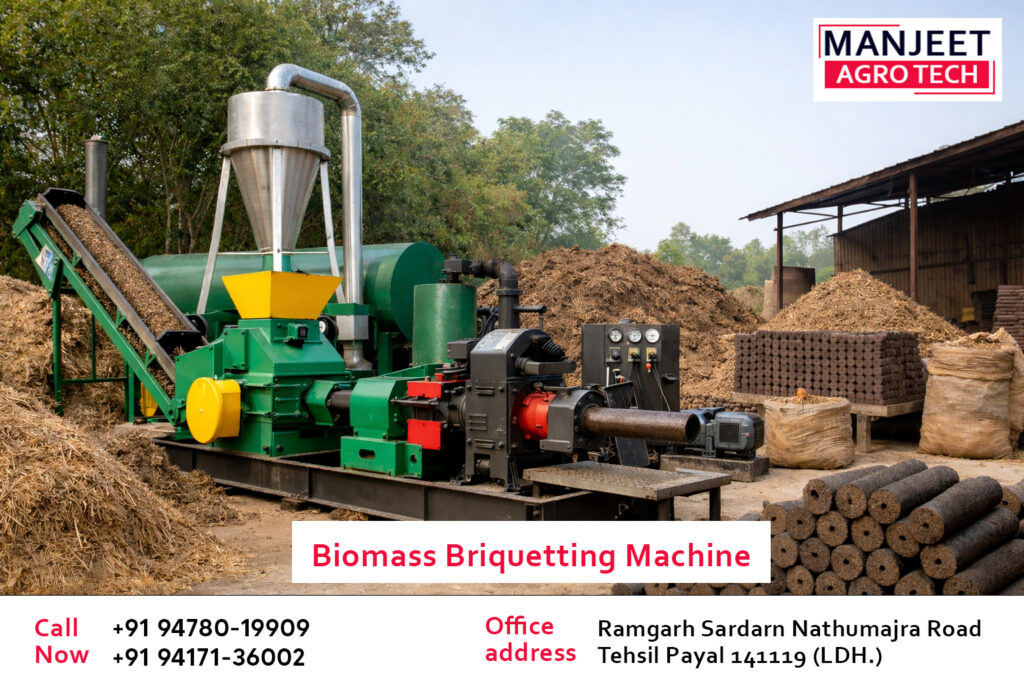
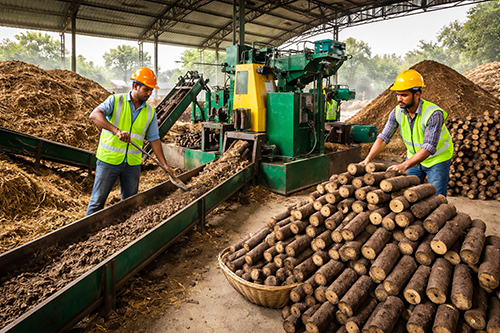
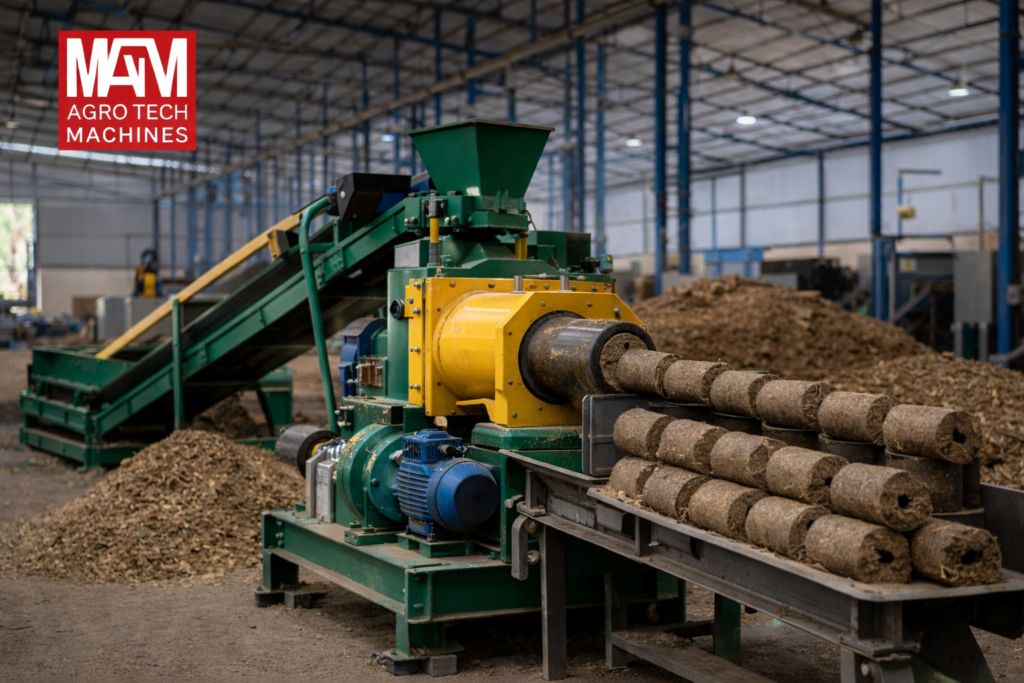
A Biomass briquette machine is an industrial machine of high heavy weight that presses agricultural and industrial waste like sawdust, rice husk, groundnut shells, bagasse into high density fuel briquettes. These are green briquettes, cheap and most common in boilers, furnaces and power plants.
In 2026, the demand of Biomass briquette machines in India is increasing at a high rate due to the increasing cost of fuel prices, and people are more aware on environmental issues.
Advantages of Biomass Briquettes
1. Green and Sustainable
Agricultural waste such as rice husk, sawdust, sugarcane bagasse, and crop residues helps produce biodiesel biomass briquettes. These materials remain bio-renewable and biodegradable. As a result, briquettes emit far less carbon compared to coal and other fossil fuels. This reduction directly lowers air pollution and supports environmental sustainability. Moreover, industries and households can use briquettes to reduce open burning of agricultural waste, which significantly contributes to smog and pollution in many regions.
2. Sustainable and Renewable Energy Source
Biomass briquettes rely on natural and renewable raw materials. Every year, farming activities generate large amounts of agricultural waste, ensuring a steady supply of raw materials. In contrast to fossil fuels, which take millions of years to form, briquettes can be produced quickly and sustainably. Therefore, they offer a reliable and long-term energy solution.
3. High Calorific Value
Biomass briquettes deliver a high calorific value, which means they generate substantial heat during combustion. Due to their dense compression, they burn efficiently and provide consistent heat output. Consequently, industries such as boilers, brick kilns, and food processing units widely use biomass briquettes as an effective alternative to coal and firewood.
4. Cost-Effective Fuel Option
One major advantage of biomass briquettes lies in their affordability. Manufacturers use agricultural waste, which keeps production costs low. As a result, industries and households can significantly reduce fuel expenses compared to coal or LPG. In addition, their uniform size lowers transportation and storage costs, making them even more economical.
5. Effortless Storage and Transportation
Biomass briquettes come in compact and uniform shapes, which makes storage and transportation easy. Unlike loose agricultural waste, briquettes require less space and allow easy stacking. Furthermore, their solid structure reduces dust and spillage during handling, improving convenience for industrial and commercial use.
6. Low Ash Content
Biomass briquettes produce minimal ash compared to coal. This feature reduces cleaning and maintenance efforts in boilers and furnaces. Additionally, users can repurpose the small amount of ash as a natural fertilizer in farming, which adds further value instead of creating waste.
7. Reduces Agricultural Waste Problems
Farmers often burn crop residues in open fields, which leads to severe air pollution and environmental damage. However, biomass briquettes offer an effective solution by converting this waste into useful fuel. Consequently, this process not only reduces pollution but also provides farmers with an additional income source when they sell agricultural residues to briquette manufacturers.
8. Supports Rural Employment
The biomass briquette industry actively creates job opportunities in rural areas. Workers participate in collecting agricultural waste, processing materials, transporting goods, and producing briquettes. As a result, this industry strengthens local economies and supports livelihoods in farming communities.
Factors Affecting Biomass Briquette Machine Price in India
1. Production Capacity
Devices that have a large production capacity (500 kg/hr-2000 kg/hr) are more expensive than low capacity devices.
2. Automation Level
Full automatic Biomass briquette machines are costly compared to semi-automatic because of the high control systems and man power requirements.
3. Raw Material Compatibility
There are specially made machines that are used to handle certain biomass products such as rice husk or sawdust, which may affect the cost.
4. Power Consumption
The machines that are eco-friendly might be a bit expensive however lower operational costs in the long term.
5. Brand & Build Quality
Established manufacturers that provide long-lasting parts and warranty are usually more expensive.
Why Invest in a Biomass Briquette Machine ?
The decision to invest in a Biomass briquette machine in 2026 is fast becoming a more viable move because it is eco-friendly, cost effective and future-oriented to a business and entrepreneur. With the global reorientation of industries towards cleaner energy source and minimization of wastes,
Biomass briquetting technology provides a viable means of converting the agricultural residual, sawdust, charcoal fines, and other biomass wastes into high-value fuel. Rather than throwing these materials away or burning them inefficiently, Biomass briquette machine converts them to small, but highly-energy-dense blocks that burn longer, cleaner, and more predictably.
Conclusion
The cost of the briquette machine in India in 2026 will be different depending on the capacity, automation, and quality. It is important that before buying products one compares the specifications, warranty, after sales services and production output. The correct machine could make you enter a profitable bio-fuel business that is profitable in the long-run.
Faq's
1. How does a biomass briquetting machine work?
Briquetting machine involves high-pressure and high-temperature compression of biomass in a manner that natural lignin in the substance acts as a bonding agent. This is typically done by drying, grinding, compression, cooling and packaging of briquettes.
2. What are the main types of biomass briquette machines?
The major types include:
Piston press briquetting machines
Screw press briquetting machines
Hydraulic briquette machines
Roller press briquetting machines
Each type differs in capacity, pressure, and briquette shape.
3. What are the benefits of biomass briquette machines?
Key benefits include:
- Takes agricultural waste and transforms it to fuel.
- Less reliance on fossil fuels and coal.
- Gives high-density fuel of high calorific value.
- Reduces carbon emissions
- Provides employment opportunities in the countryside.
4. What maintenance is required for briquetting machines?
Regular maintenance includes:
Lubrication of mechanical parts
Replacement of dies and screws
Cleaning raw material feeding systems
Checking hydraulic pressure and motor performance.
5. What industries use biomass briquettes in India?
Biomass briquettes are widely used in industries such as:
Textile mills
Food processing units
Brick kilns
Paper mills
Chemical industries
Thermal power plants
They are used as fuel for boilers and furnaces.